The Meta Ad Strategy That Generated 5x ROAS for Our Client
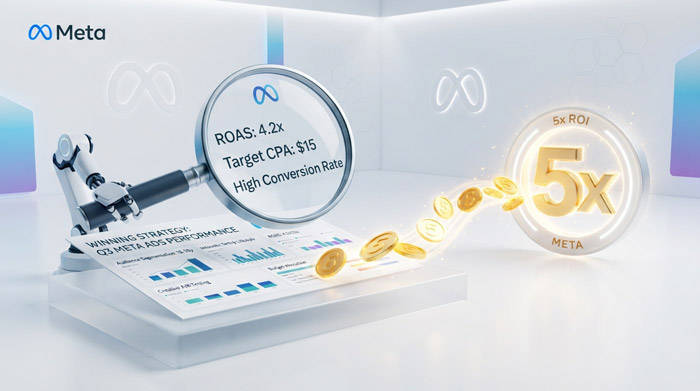
Running Meta Ads isn’t just about boosting posts or launching campaigns. Today’s digital advertising landscape requires a strategic approach that combines audience research, compelling creatives, continuous optimization, and data-driven decisions.
Many businesses invest heavily in Facebook and Instagram advertising but fail to achieve consistent results. The difference often lies not in the advertising budget but in the strategy behind it.
In this case study, we’ll walk through a Meta Ads strategy that significantly improved campaign performance for one of our clients. While every business is unique, the principles shared here can help brands create more effective advertising campaigns and maximize their return on investment.
Project Overview
The client approached us with three primary goals:
- Increase qualified leads
- Reduce cost per acquisition (CPA)
- Improve overall Return on Ad Spend (ROAS)
Despite running multiple campaigns, their previous setup struggled with inconsistent performance, high advertising costs, and limited conversion tracking.
Initial Challenges
Before making any changes, we audited the existing Meta Ads account and identified several issues:
- Broad audience targeting
- Weak ad creatives
- No clear sales funnel
- Limited conversion tracking
- Overlapping audience segments
- No retargeting campaigns
- Inconsistent budget allocation
These issues prevented the campaigns from reaching their full potential.
Step 1: Audience Research
Rather than targeting everyone, we focused on understanding the client’s ideal customers.
We analyzed:
- Customer demographics
- Interests
- Online behavior
- Purchase intent
- Geographic location
- Device usage
Based on this research, we created multiple audience segments instead of relying on a single broad audience.
Audience Types
- Interest-Based Audiences
- Lookalike Audiences
- Website Visitors
- Previous Customers
- Engaged Social Media Users
This segmentation allowed us to deliver more relevant ads to each audience group.
Step 2: Conversion Tracking
Accurate tracking is essential for campaign optimization.
We implemented:
- Meta Pixel
- Conversion API (CAPI)
- Custom Events
- Lead Tracking
- Purchase Tracking
These tools provided reliable data, enabling better optimization and more informed decision-making.
Step 3: Creative Optimization
Creative quality often determines whether users stop scrolling and engage with your ad.
We redesigned the ad creatives with a focus on:
- Clear messaging
- Strong value proposition
- High-quality visuals
- Consistent branding
- Mobile-friendly design
- Clear call-to-action (CTA)
Creative Formats Used
- Static Images
- Carousel Ads
- Short-form Videos
- Testimonial Creatives
- Before-and-After Graphics
- User-Generated Content (UGC)
Testing multiple formats helped identify the best-performing creatives.
Step 4: Campaign Structure
Instead of placing all ads in a single campaign, we built a structured funnel.
Top of Funnel (TOFU)
Goal:
- Brand Awareness
- Reach
- Video Views
Audience:
- Cold Audience
- Interest Targeting
- Lookalike Audience
Middle of Funnel (MOFU)
Goal:
- Website Traffic
- Engagement
- Landing Page Views
Audience:
- Video Viewers
- Website Visitors
- Social Media Engagement
Bottom of Funnel (BOFU)
Goal:
- Lead Generation
- Purchases
- Contact Form Submissions
Audience:
- Cart Abandoners
- Returning Visitors
- Previous Leads
This funnel ensured that users received relevant messaging based on where they were in the buying journey.
Step 5: A/B Testing
Rather than assuming which ads would perform best, we tested multiple variables.
What We Tested
- Headlines
- Ad Copy
- Images
- Videos
- CTAs
- Landing Pages
- Audience Segments
Small improvements across multiple elements resulted in significant gains in campaign performance.
Step 6: Budget Optimization
Instead of distributing the budget equally, we shifted spend toward high-performing campaigns.
Our optimization process included:
- Scaling winning campaigns
- Pausing underperforming ads
- Monitoring frequency
- Adjusting placements
- Managing daily budgets
This approach improved efficiency and reduced wasted ad spend.
Step 7: Landing Page Improvements
Driving traffic is only half the battle. A poorly optimized landing page can reduce conversions.
We improved:
- Page speed
- Mobile responsiveness
- Form simplicity
- CTA placement
- Trust signals
- Testimonials
- Visual hierarchy
These changes created a smoother user experience and encouraged more visitors to convert.
Results Achieved
After implementing the strategy, the campaigns showed measurable improvements.
| Metric | Before | After |
|---|---|---|
| ROAS | 1.8x | 5.0x |
| Cost Per Lead | ₹1,250 | ₹520 |
| Click-Through Rate (CTR) | 1.4% | 3.9% |
| Conversion Rate | 3.2% | 8.7% |
| Cost Per Click (CPC) | ₹42 | ₹21 |
| Qualified Leads | 65/month | 210/month |
Note: These figures are presented as an illustrative case study to demonstrate how strategic optimization can improve campaign performance. Actual results vary depending on industry, budget, competition, and campaign execution.
Key Takeaways
Successful Meta Ads campaigns are built on strategy, not guesswork.
The biggest improvements came from:
- Better audience segmentation
- Accurate conversion tracking
- High-quality creatives
- Continuous A/B testing
- Funnel-based campaign structure
- Landing page optimization
- Ongoing performance analysis
Together, these elements helped improve efficiency and maximize return on advertising spend.
Common Mistakes Businesses Make
Avoid these common Meta Ads mistakes:
- Targeting overly broad audiences
- Running only one creative
- Ignoring conversion tracking
- Sending traffic to poor landing pages
- Scaling campaigns too quickly
- Not testing new creatives
- Failing to monitor campaign performance regularly
Best Practices for Meta Ads in 2026
- Install Meta Pixel and Conversion API.
- Use high-quality visuals and videos.
- Build campaigns around a marketing funnel.
- Test multiple audience segments.
- Refresh creatives regularly to avoid ad fatigue.
- Optimize for conversions rather than clicks.
- Review campaign data weekly and make informed adjustments.
Conclusion
Meta Ads continue to be one of the most effective digital advertising platforms when backed by a well-planned strategy. Success isn’t about spending the largest budget—it’s about reaching the right audience with the right message at the right time.
By focusing on audience research, creative testing, conversion tracking, and continuous optimization, businesses can improve campaign performance, reduce acquisition costs, and generate stronger returns on their advertising investment.
If you’re looking to improve your Meta Ads performance, a structured, data-driven approach can help you achieve more consistent and sustainable results.
Frequently Asked Questions
ROAS (Return on Ad Spend) measures how much revenue is generated for every amount spent on advertising. A higher ROAS indicates more effective campaigns.
Targeting the right audience ensures your ads are shown to people who are more likely to engage and convert, improving campaign efficiency.
Yes. Using both provides more accurate conversion tracking and helps optimize campaigns, especially in a privacy-focused advertising environment.
Campaigns should be monitored regularly, with weekly reviews of key metrics such as CTR, CPC, CPA, and ROAS. Creatives should also be refreshed periodically to prevent ad fatigue.
Absolutely. Even with modest budgets, well-targeted Meta Ads campaigns can help small businesses generate leads, increase sales, and build brand awareness.